
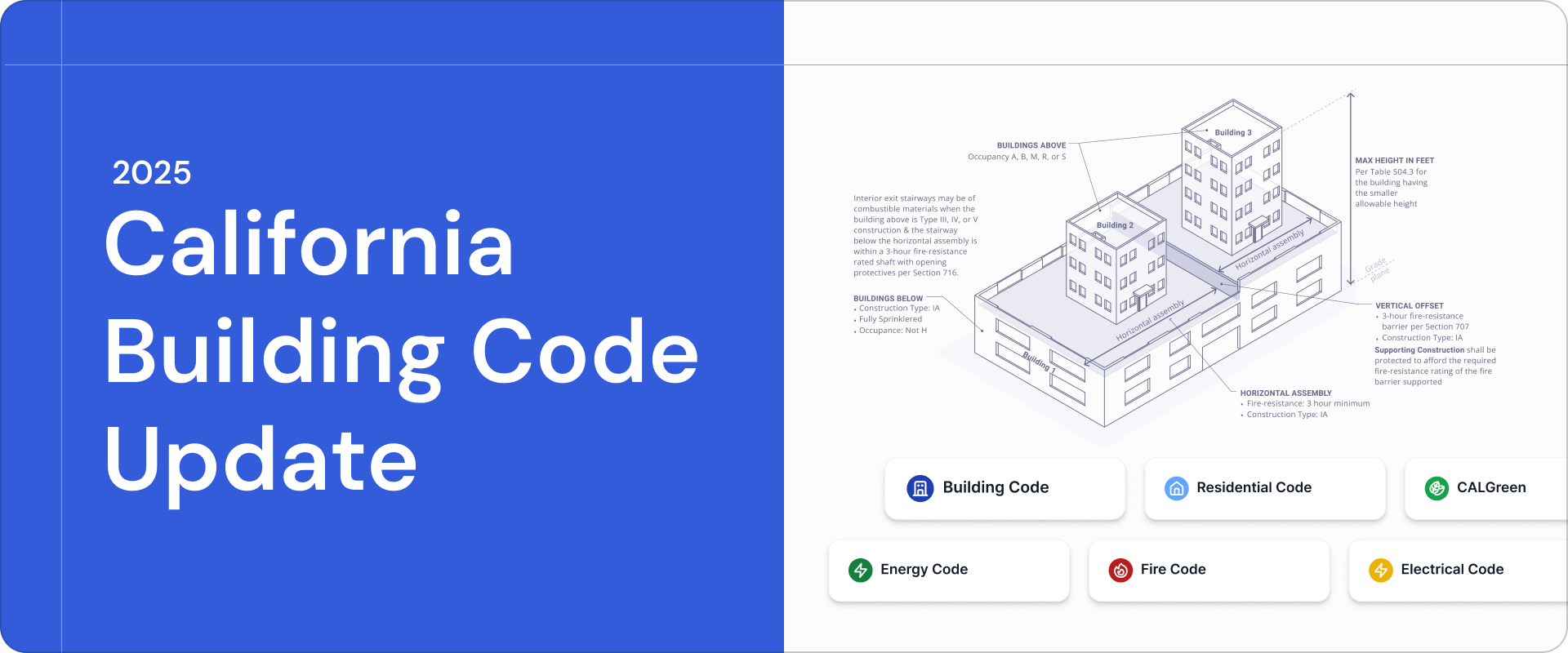

With California's latest Title 24 update now in effect as of January 1, 2026, we wanted to highlight a few interesting changes.
If you're planning to pull a permit in California this year, use this summary to build out your compliance checklist. Keep in mind that this is only a high-level overview. For specific requirements, please reference the code directly.
Fire Safety Updates for Wall Construction, Podium Buildings, and Battery Storage
The 2025 California Building Code now includes more information on how horizontal separation between podium levels is treated and how vertical offsets need fire barrier treatment. There are also more explicit requirements for fire-resistance-rated exterior walls. Additionally, lithium-ion and similar battery storage installations now have dedicated fire-safety provisions, like emergency response, signage, and hazard classification.
New Electric-Ready Infrastructure Regulations
The 2025 California Energy Code has new electric-ready requirements for heat pumps, solar, battery storage, and EV charging. The changes encourage the use of electric heat pump technology for space and water heating in newly constructed buildings. The baseline for new construction moves toward dual heat pumps, including space and water, rather than just one of those functions. For non-residential and high-rise multifamily buildings, there are more stringent requirements for solar and storage integration.
Bicycle Parking Is Now Mandatory
The 2025 California Green Building Standards Code (CALGreen) incorporates new mandatory measures for bicycle parking serving multifamily dwellings, hotels, and motels. What had been voluntary in earlier versions of CALGreen is now mandatory.
Projects such as new multifamily housing developments and new hotels and motels must now include on-site bicycle parking (both long-term and short-term).
Local jurisdictions may still adopt more stringent standards, but the state minimum is now mandatory. Having just vehicle parking isn’t sufficient: the building permit submission must include a bike parking design and ensure compliance with the state standard.
California Wildlife and Urban Interface Code
The 2025 California WUI Code is now its own standalone code. It establishes minimum requirements to reduce the likelihood of loss of life and property due to wildfire.
The WUI Code provides the performance and prescriptive requirements for construction and development in all Fire Hazard Severity Zones in State Responsibility Areas (SRA) and Local Responsibility Areas (LRA) designated as Very High Fire Hazard Severity Zones. It also increases the ability of buildings located in any Fire Hazard Severity Zone within State Responsibility Areas (SRA), or Wildland-Urban Interface (WUI) Areas, to resist the intrusion of flames or burning embers projected by a vegetation fire.
California 2025 Building Code Checklist
- Check your project permit date. If your permit application is submitted on or after January 1, 2026, it’s subject to 2025 Title 24.
- Evaluate electric readiness. Check how your project scope might need to change to comply with conduit stub‐outs, panel space, signage, and more.
- Verify your project’s fire hazard zone. If your project is in a fire hazard severity zone or high WUI area, check the new standalone WUI code and how it impacts your design.
- Assess bicycle parking requirements. Ensure your multifamily, hotel, and motel projects meet the new bicycle parking regulations in CALGreen.
new content.